How Image Recognition Technology is Transforming PPAP Compliance
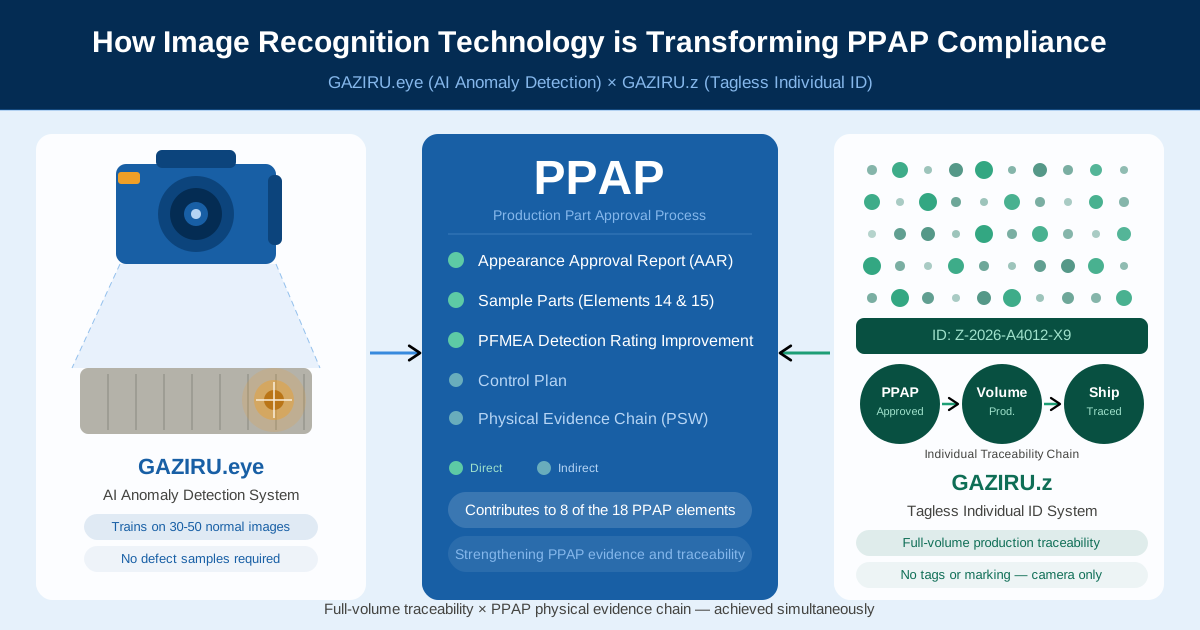
For automotive parts suppliers, PPAP (Production Part Approval Process) is the critical gateway before mass production can begin. Preparing 18 categories of submission documents, obtaining appearance approvals, demonstrating process capability—relying on manual methods for all of this drives up both cost and effort, while leaving questions about the objectivity of quality evidence. This article explains how GAZIRU.z and GAZIRU.eye, two image recognition technologies, can contribute to each stage of the PPAP compliance process—with clear technical reasoning behind every claim.
1. What is PPAP?
PPAP stands for Production Part Approval Process. It is the standard process used in the automotive industry to demonstrate, before mass production begins, that a supplier's manufacturing process meets customer design and quality requirements. It is a core process within IATF 16949 (the automotive quality management system standard), and is structured around 18 submission elements and 5 submission levels.
For a detailed overview of the 18 elements and submission levels, see the Wikipedia article on PPAP, which summarises the official AIAG manual in accessible language.
2. What are GAZIRU.z and GAZIRU.eye?
GAZIRU.z — Tagless Individual Identification System
GAZIRU.z is a tagless individual identification system that identifies individual parts using only the microscopic surface patterns naturally present on each part—no RFID tags or QR codes required. Just as human fingerprints are unique to each person, these surface patterns are unique to each part. GAZIRU.z reads them with high precision and matches them against a database to identify individual items. No physical modification or tagging of products is needed; identification is complete with a single camera image.
- Matching speed: 30,000 comparisons per second, supporting real-time identification on high-volume production lines
- Use cases: traceability, physical verification, sample management
GAZIRU.eye — AI Anomaly Detection System
GAZIRU.eye is an AI anomaly detection system built on an unsupervised learning approach that requires only normal (non-defective) images for training—no defect samples needed. A reliable model can be built from just 30–50 images of normal parts, and the detection threshold can be tuned to match the quality requirements of each production environment.
- Output: anomaly score across the entire part, anomaly heatmap, and pass/fail result
- Strength: consistent, automated detection of appearance defects that are difficult to define explicitly, such as scratches, dents, and discolouration
3. Mapping to the 18 PPAP Elements
The table below summarises the direct and indirect contributions that GAZIRU.z and GAZIRU.eye can make to the PPAP submission elements.
# | Element | Product | Contribution | Level |
|---|---|---|---|---|
13 | Appearance Approval Report (AAR) | GAZIRU.eye + GAZIRU.z | AI anomaly detection results supplement appearance evidence. GAZIRU.z records proof that the approved physical part is identical to the submitted sample (subject to customer acceptance). | Strong |
14 | Sample Production Parts | GAZIRU.z | The individual identification number of the submitted sample is registered in the database, providing digital proof that this physical part is the PPAP submission. | Strong |
15 | Master Sample | GAZIRU.z | Master samples are registered in the database and serve as the reference for future physical verification. | Strong |
5 | Process Flow Diagram | GAZIRU.eye | Provides justification for formally defining the anomaly detection step as a quality gate in the process flow. | Indirect |
6 | PFMEA | GAZIRU.eye | Offers quantitative evidence to support a lower Detection rating (D), contributing to reduced RPN values. | Indirect |
7 | Control Plan | GAZIRU.eye | Detection thresholds can be defined as control characteristics; supports automation of inspection frequency and reaction plans (subject to customer/auditor acceptance). | Indirect |
16 | Checking Aids | GAZIRU.eye | The AI anomaly detection system itself can be registered as a checking aid. | Indirect |
18 | Part Submission Warrant (PSW) | GAZIRU.z | The individual identification number of the physical part is recorded at the time of PSW sign-off, creating a traceable record for future reference. | Indirect |
4. Key Differentiating Contributions
4-1. GAZIRU.z: Individual Traceability from PPAP through Full-Volume Production
GAZIRU.z makes its strongest contribution to Elements 13 (AAR), 14 (Sample Production Parts), and 15 (Master Sample). The shared challenge across all three is demonstrating that the physical parts actually correspond to the paperwork.
The system creates a chain of physical evidence as follows. Production-representative samples from the significant production run are photographed and their individual identification numbers registered in the database. The sample submitted to the customer (Element 14) and the master sample retained by the supplier (Element 15) are separate physical parts, but both are registered as having been produced in the same significant production run. At the time of the customer's appearance approval (Element 13 / AAR), the identification number of the approved part is recorded—providing digital proof that the part approved in the AAR was produced in the same significant production run as Elements 14 and 15. Traditional serial-number-based traceability leaves only a record that a number was attached. GAZIRU.z treats the physical surface itself as the identifier, producing tamper-resistant evidence that no substitution or mix-up occurred during the approval process.
For suppliers managing high-mix, low-volume production, the benefit is even greater. Handling multiple samples and master samples across many part numbers creates a high risk of mix-ups and a significant administrative burden. Because GAZIRU.z requires only a photograph to register and verify a part, management costs remain manageable regardless of how many part numbers are added.
Furthermore, adopting GAZIRU.z for PPAP sample management is the first step toward building an individual traceability system for the entire production volume. By integrating with the Control Plan (Element 7), the system can scale seamlessly into full per-unit tracking of manufacturing and inspection history throughout the production phase after PPAP approval. The ability to demonstrate, from the physical part itself, exactly when and through which process each unit passed is highly valuable for root-cause analysis of field complaints and for defining the scope of any recall.
4-2. GAZIRU.eye: Quantitative Justification for a Lower Detection Rating (D) in PFMEA
In PFMEA, the Risk Priority Number (RPN) is calculated as Occurrence (O) × Severity (S) × Detection (D). The Detection rating represents the probability that a defect, once it occurs, will be caught before shipment. A lower score indicates stronger detection capability; a higher score indicates a greater risk of defects escaping undetected.
When visual inspection is the sole detection method for appearance defects, it is difficult to justify a low Detection score objectively. If a customer or third-party auditor challenges the rating and determines that detection capability has been overestimated, the supplier will be required to revise D upward to reflect the true capability. Because RPN = O × S × D, a higher D value directly increases the RPN, which may then exceed the acceptable threshold—triggering a requirement for additional corrective actions and extending the PPAP review process.
By introducing GAZIRU.eye, suppliers can support a Detection rating claim with concrete, statistical evidence: "This system justifies a Detection rating of D=X." The shift from subjective, person-dependent explanations to objective, system-based evidence significantly strengthens the PFMEA submission.
4-3. Strengthening AAR Evidence
By building a workflow in which GAZIRU.eye automatically generates anomaly score distribution data and anomaly heatmaps at the time of appearance approval, suppliers can present customers with a multi-layered body of evidence alongside traditional visual inspection results. Whether customers will formally accept AI anomaly detection results as part of the AAR will depend on individual agreements, but the supplementary value of this evidence is substantial.
5. Business Benefits and ROI
Efficiency Gains
- Automated AAR documentation: Automatic recording of heatmaps and scores significantly reduces the time required to prepare appearance approval reports.
- Streamlined sample management: Digital registration of individual identification numbers reduces the labour required to store and verify physical samples.
- More efficient PFMEA updates: As detection data accumulates, periodic PFMEA reviews can be conducted with a solid, data-backed rationale.
Quality Risk Reduction
- Physical evidence chain for PPAP samples eliminates the risk of substitution or mix-up after approval (GAZIRU.z)
- 100% automated appearance inspection during initial production flow minimises the risk of defective parts reaching the customer (GAZIRU.eye)
- Shift from person-dependent visual inspection to objective AI-based judgement eliminates inspection variability
Higher PPAP Approval Rates
More objective and comprehensive evidence reduces the likelihood of rework during customer review, enabling a smoother path to PPAP approval. The effect is particularly pronounced for parts with strict appearance requirements, such as automotive interior and design-critical components.
Conclusion
GAZIRU.z and GAZIRU.eye are not a replacement for all 18 PPAP elements. However, in the areas of physical evidence chains within the PPAP process, automated generation of appearance evidence, and improved Detection ratings in PFMEA, they make it possible to achieve a level of objectivity and efficiency in PPAP compliance that manual methods simply cannot match.
If you are an automotive parts manufacturer or supplier looking to reduce the time and effort required for PPAP compliance while strengthening your quality evidence, please feel free to contact GAZIRU.