Bring the process and cost of tags, labels, and engraving to zero
Instead of a tag, a label or laser engraving, we use the item's own surface pattern as its ID — so the whole cost of applying, peeling off and engraving disappears. This page introduces GAZIRU.z's tagless identification, which works even on parts too small to tag and materials you can't engrave.
Typical challenges
Tags ruin the design / laser engraving is expensive or impossible / removing tags before shipment / relabeling purchased parts with our own tags
With GAZIRU
- The steps of attaching, removing, and engraving disappear — just register the item as it is
- Works even for small parts you can't tag, materials you can't engrave, and products where you don't want to change the look
- Purchased parts and supplied items can be managed without your own labels — just photograph and register them on receipt
Comparison with conventional methods
| Labels / tags | RFID | Laser engraving | GAZIRU (tagless) | |
|---|---|---|---|---|
| Attach / engrave process | Required | Required | Required | Not required |
| Removal process | Sometimes required | Sometimes required | — | Not required |
| Small parts & special materials | Sometimes can't be attached | Sometimes can't be attached | Some materials can't be engraved | Possible if the surface has a pattern※2 |
| Tag swapping & counterfeiting | Possible | Possible | Difficult | Difficult (the item itself is the ID) |
| Visual impact | Yes | Yes | Yes | None |
How it works
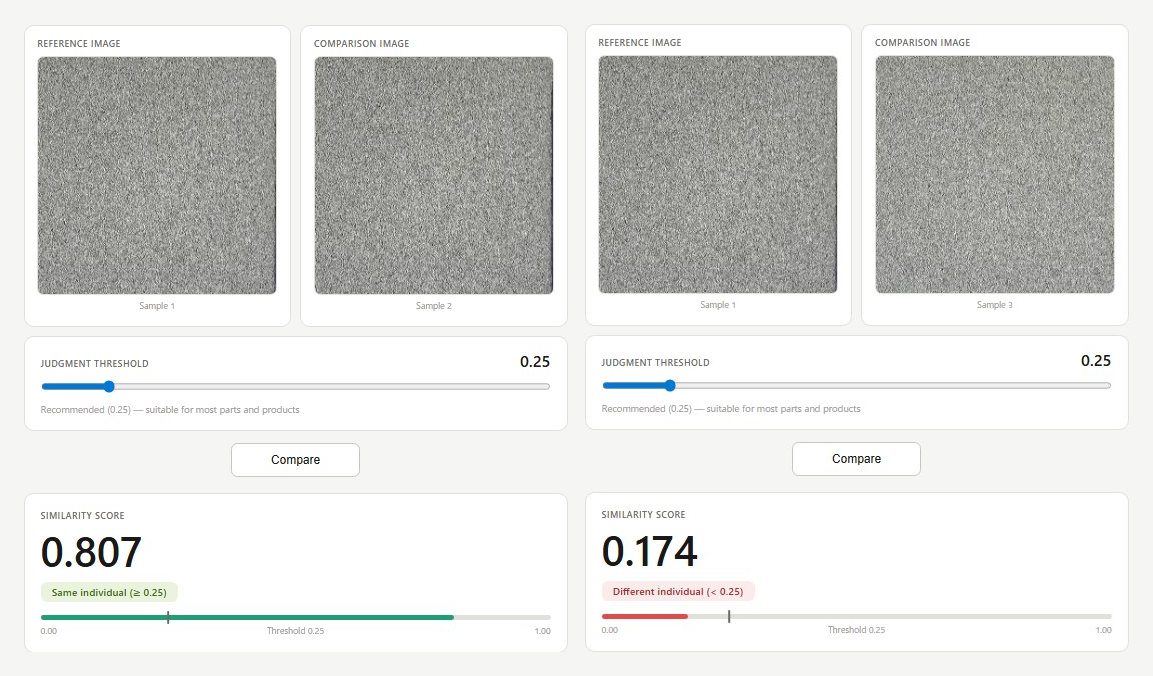
Instead of a tag or label, you decide which spot on the item to use for identification (the imaging spot). Photograph that spot and pass the image to GAZIRU.z, which extracts features from it and registers them in the registry. At matching time, photograph the same spot and match it. Differences in imaging conditions between registration and matching can be corrected on the server side to a certain extent.※1
Industries
Automotive parts / electronic components / materials / industrial parts / industrial machinery & equipment
Related articles
Notes
※1 The alignment feature automatically corrects, where possible, differences in shooting position and orientation at match time, and assists identification accuracy by raising the score only for the same (correct) individual.
※2 This assumes the surface has fine patterns (processing marks or the material's own texture) and that the same spot can be imaged consistently at registration and matching. Even where processing or the like changes part of the surface pattern, the individual can be identified from the remaining features (depending on conditions). Applicability is determined by verification in advance; please consult us in particular for low-contrast or plain surfaces.
Other solutions
Individual traceability
Narrow recalls to the individual unit. Link process data to each item.
Autonomous manufacturing lines
Emerging use caseMatch the physical item at every robot-to-robot handoff.
Genuine product verification & anti-substitution
Determine whether an item is the one you registered, based on identity with the registered individual.
DPP & linking physical items to digital records
Emerging use caseTurn the physical item itself into the product ID.
AI visual inspection (anomaly detection)
Get started with normal images alone, and move to 100% inspection.
Counting & classification
Count and sort in a single shot.