The Era of AI Hiring AI: Why "Physical Fingerprints" are the Bedrock of Unmanned Factories
Introduction
In my previous post, I discussed the near future of autonomous vehicles—supporting human mobility by day and seamlessly integrating into automated delivery systems by night.
Today, I want to take this vision a step further. We need to talk about a fundamental shift in "who" is making the decisions, and why this leads us directly to the true value of unmanned factories.
1. From Human-Centric to AI-Centric Operations
In the near future, the primary "client" for an autonomous vehicle or a factory robot will no longer be a human. It will be another AI agent.
The reason is simple: Scale and Speed.
- Scale: There are 8 billion humans, but the number of AI agents is growing exponentially.
- Speed: Humans are slow decision-makers. We hesitate, we research, we consult, and we navigate complex social hierarchies. While important for society, this is a "high-cost delay" in terms of economic optimization.
AI agents, however, operate based on objective functions, constraints, and success probabilities. They make decisions in milliseconds without the "emotional cost." As a result, the majority of economic activity will shift to AI-to-AI transactions, where one agent requests a task and another delivers the result.
2. The Unmanned Factory: A Society of Autonomous Agents
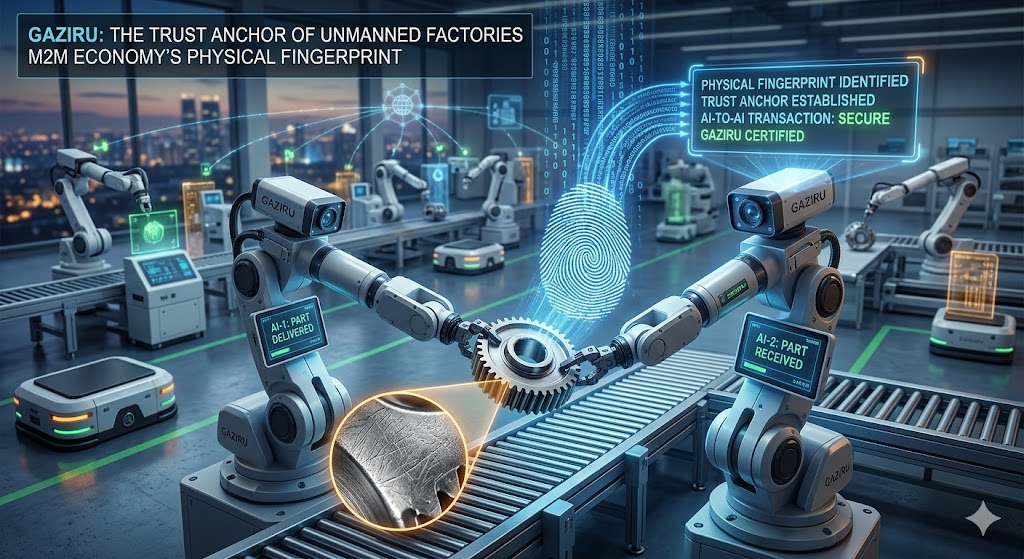
This shift is most evident in the "Unmanned Factory." To us, an unmanned factory isn’t just a building full of moving machines; it is a community of autonomous AI agents.
Imagine:
- A logistics robot (AI) delivers a part.
- An assembly arm (AI) receives and installs it.
- An inspection system (AI) verifies the work.
In this world, because humans aren't there to double-check everything, there must be an absolute, "unforgeable" proof of delivery. In the digital world, we use encryption and "digital fingerprints." But in the physical world, how do you lock a piece of metal or plastic?
3. The Flaw in Labels: Why QR Codes Aren't Enough
Until now, we’ve relied on RFID tags or QR codes to identify objects. But in a fully autonomous society, these are vulnerabilities.
- Tags can fall off.
- Labels can be forged or swapped.
- Applying tags to every tiny component is often too expensive.
This is where our technology, GAZIRU, changes the game.
4. "Physical Fingerprints": The Missing Piece of the Puzzle
Every object has microscopic unique features—scratches, textures, and patterns created during manufacturing. These are "Physical Fingerprints" that are virtually impossible to replicate.
By using only an image to identify these unique traits, we create a bridge between the physical and digital worlds that is:
- Tamper-proof: You cannot "swap" the object’s own surface.
- Passive: No need to attach or modify the object.
- Universal: Anything with a surface can be identified.
We often talk about the many technologies needed for an unmanned factory—5G, advanced robotics, and powerful AI. But no matter how fast the robot is, the system fails if it cannot trust that "Object A" is truly "Object A."
GAZIRU is that final piece of the puzzle. It provides the "Trust Anchor" that allows AI agents to exchange physical goods with the same level of certainty we have in the digital world.
Conclusion
As we move toward this future, the role of humans will evolve. We will move away from micro-managing tasks and toward designing the structures and defining the responsibilities of these AI societies.
To make that world a reality, we need a foundation of absolute trust in the physical world. We are proud to provide the technology that makes that trust possible.